Fastest
contributed programs, grouped by programming language implementation
shamelessly borrowed from The Computer Language Benchmarks Game
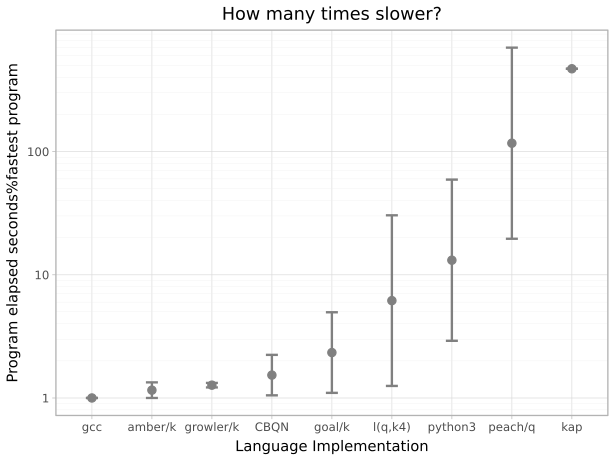
× source 2^ secs mem gz cpu secs 1.00 collatz.c 18 0.103 2,400
819 0.101 1.33 collatz.growler.k 18 0.137 5,030
1,005 0.134 1.34 collatz.amber.k 18 0.138 27,308
1,003 0.136 2.24 collatz.bqn 18 0.231 9,806
1,340 0.228 2.91 collatz.py 18 0.301 13,914
485 0.275 4.96 collatz.goal 18 0.513 52,077
528 0.696 30.4 collatz.l.q 18 3.14 14,160
652 3.14 470. collatz.kap 18 48.6 233,957
174 49.4 698. collatz.peach.q 18 72.1 19,165
656 72 1.00 spectralnorm.amber.k 12 0.444 306,754
386 0.442 1.05 spectralnorm.bqn 12 0.466 278,966
291 0.463 1.10 spectralnorm.goal 12 0.489 274,026
259 0.497 1.22 spectralnorm.growler.k 12 0.541 306,495
208 0.537 1.25 spectralnorm.l.q 12 0.556 301,769
273 0.557 19.6 spectralnorm.peach.q 12 8.7 305,611
277 8.67 59.2 spectralnorm.py 12 26.3 1,366,389
308 26.3
This is the round 2 of the benchmarks game. See Round 1 for the previous round performance.
See description of spectralnorm. collatz requires the length of the collatz sequence starting at 1+2^x
Reference implementations are spectralnorm.py and collatz.py
Please contribute more programs for your favourite array language. There is no restriction on algorithms, unlike the CLBG.
It's never too late to add your language to this round or previous rounds or to improve any program.
Please propose interesting new benchmarks
The benchmark is run on an i5-1135g7 (tiger lake, some avx512) and each process is limited to 2GB of memory