Fastest
contributed programs, grouped by programming language implementation
shamelessly borrowed from The Computer Language Benchmarks Game
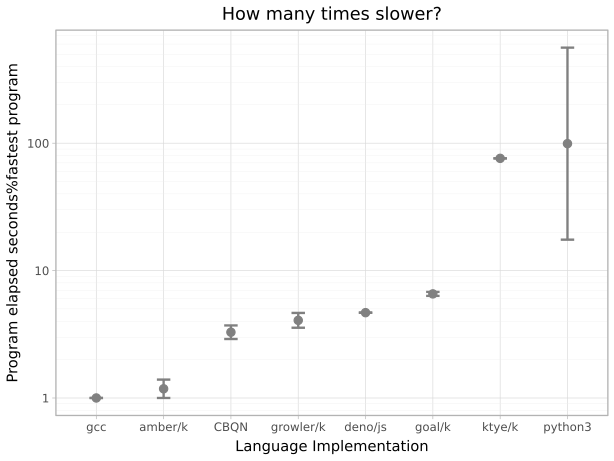
× source 2^ secs mem gz cpu secs 1.00 fft.c 23 0.17 207,217
1,556 0.328 1.39 fft.amber.k 23 0.237 847,032
2,095 0.761 3.56 fft.growler.k 23 0.604 599,577
887 0.601 3.71 fft.bqn 23 0.63 692,359
1,041 0.627 4.67 fft.deno.js 23 0.794 356,626
892 0.806 6.33 fft.goal 23 1.07 1,000,313
919 1.14 17.5 fft.py 23 2.97 761,512
666 3.6 76.0 fft.ktye.k 23 12.9 928,186
298 12.9 1.00 mandelbrot.amber.k 13 0.196 157,811
611 0.635 2.90 mandelbrot.bqn 13 0.571 49,336
862 0.563 4.65 mandelbrot.growler.k 13 0.914 37,581
481 0.907 6.80 mandelbrot.goal 13 1.34 62,587
574 3.97 562. mandelbrot.py 13 111 13,693
476 110
This is the current round of the benchmarks game. See Round 2 for the last round performance.
. mandelbrot requires an x by x portable bitmap (pbm) of the mandelbrot set
. fft requires the top 10 frequencies detected in the input. input is one second of a signal and is generated with a simple prng. list a table of frequencies with tab separated frequency and amplitude up to 9 decimal places.
Reference implementations are mandelbrot.py and fft.py
Please contribute more programs for your favourite array language. There is no restriction on algorithms, unlike the CLBG.
It's never too late to add your language to this round or previous rounds or to improve any program.
Please propose interesting new benchmarks
The benchmark is run on an i5-1135g7 (tiger lake, some avx512) and each process is limited to 2GB of memory