Fastest
contributed programs, grouped by programming language implementation
shamelessly borrowed from The Computer Language Benchmarks Game
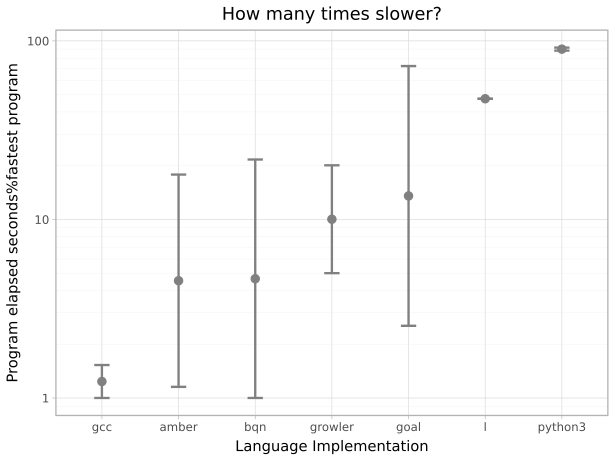
× source 2^ secs mem gz cpu secs 1.00 knucleotide.bqn 25 0.313 540,869
1,177 0.309 1.15 knucleotide.amber.k 25 0.361 368,095
501 0.359 1.53 knucleotide.c 25 0.478 170,639
1,688 0.477 x knucleotide.l.q 25 'memory(9) 1,999,999
469 'memory(9) 2.54 knucleotide.goal 25 0.794 1,071,469
281 1.3 5.00 knucleotide.growler.k 25 1.56 345,555
503 1.56 x knucleotide.peach.q 25 'nan(1) 1,080,988
473 'nan(1) 91.7 knucleotide.py 25 28.7 688,685
724 28.7 1.00 nbody.c 23 0.308 2,494
1,303 0.306 17.8 nbody.amber.k 23 5.49 26,042
958 5.49 20.1 nbody.growler.k 23 6.19 4,047
960 6.18 21.7 nbody.bqn 23 6.67 9,347
1,153 6.66 47.4 nbody.l.k 23 14.6 12,100
945 14.6 72.3 nbody.goal 23 22.2 19,370
1,034 24.8 88.2 nbody.py 23 27.1 15,225
1,411 27.1 x nbody.peach.q 23 'walltime(9) 20,435
1,068 'walltime(9)
These are the descriptions for nbody and knucleotide benchmarks.
Reference implementations are nbody.py and knucleotide.py
Python and gcc are included in the game as the languages to beat.
Please contribute more programs for your favourite array language. There is no restriction on algorithms, unlike the CLBG.
It's never too late to add your language to this round or previous rounds or to improve any program.
Please propose interesting new benchmarks
The benchmark is run on an i5-1135g7 (tiger lake, some avx512) and each process is limited to 2GB of memory